
Cursor
ProductA product discussed on Dwarkesh Patel.
2 episodes
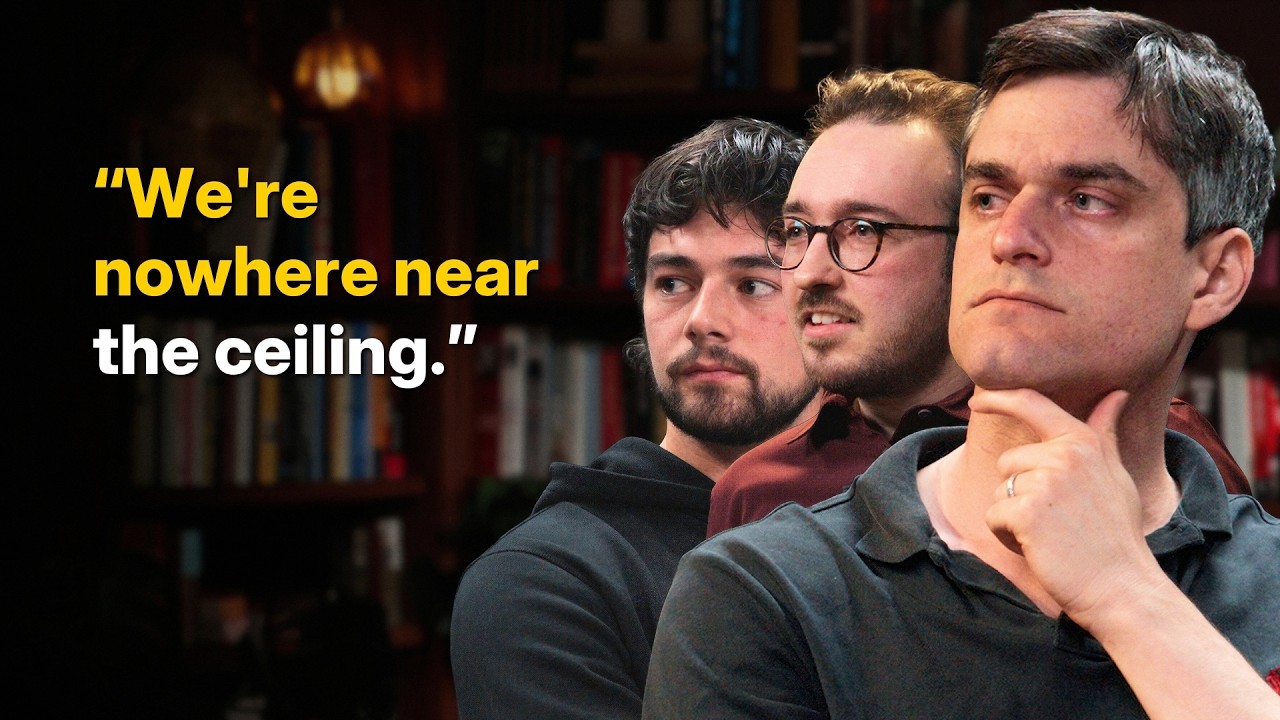
AI researchers debate how close we are to recursive self-improvement
Sep 11, 2026 · 1:37:01
Dwarkesh Patel hosts John Schulman (Thinking Machines), Beren Millidge (Zyphra), and Charlie O'Neill (Baseten) to debate how close recursive self-improvement is. They argue the main risk to superintelligence by 2036 is a persistent sim-to-real gap: models ace benchmarks but cannot set their own objectives for paradigm-shifting research. Schulman says defining the objective—alignment—will be humans' longest-lasting job, and distillation from frontier models fights lab centralization. Millidge credits RL's success to high-signal bits atop strong mid-training and warns continual learning fails via catastrophic forgetting. Timelines: a drop-in remote worker in one to three years, Schulman gives a 10x AI-researcher uplift in two and AI dominating all computer work in three to four.

General relativity from first principles – Adam Brown
Jul 10, 2026 · 1:38:25
Adam Brown, lead of Blueshift at Google DeepMind, explains general relativity from two clues: the finite speed of light and the equivalence principle—inertial and gravitational mass equal to one part in 10^15. Einstein inferred gravity as an inertial force: free-falling objects follow straight lines in curved spacetime. Brown describes black holes: the event horizon at 2GM/c^2 where escape is impossible, gravitational time dilation slowing clocks near the horizon by sqrt(1-2GM/rc^2), and extracting 100% of rest energy. He recounts the 1919 eclipse confirming light bends twice Newton's prediction, LIGO's detections, and the Event Horizon Telescope. Finally, he considers AI could rediscover such theories by exploring consistency, and might become superhuman explainers.
Powered by PodHood